S3
This guide covers Amazon S3 and S3 compatible storage, which you connect with the same S3 item by entering its server address. For the parts of the Add drive form that every storage shares, see Add a drive.
Before you start
You need an access key: an access key ID and its secret key. Create one in your AWS account or in the console of your S3 compatible storage. For S3 compatible storage, also find its server address (endpoint) in the provider's documentation.
Connect to S3
- Click Drives in the left menu, and then click Add drive.
- In Storage type, choose S3. It is in the Frequently used group.
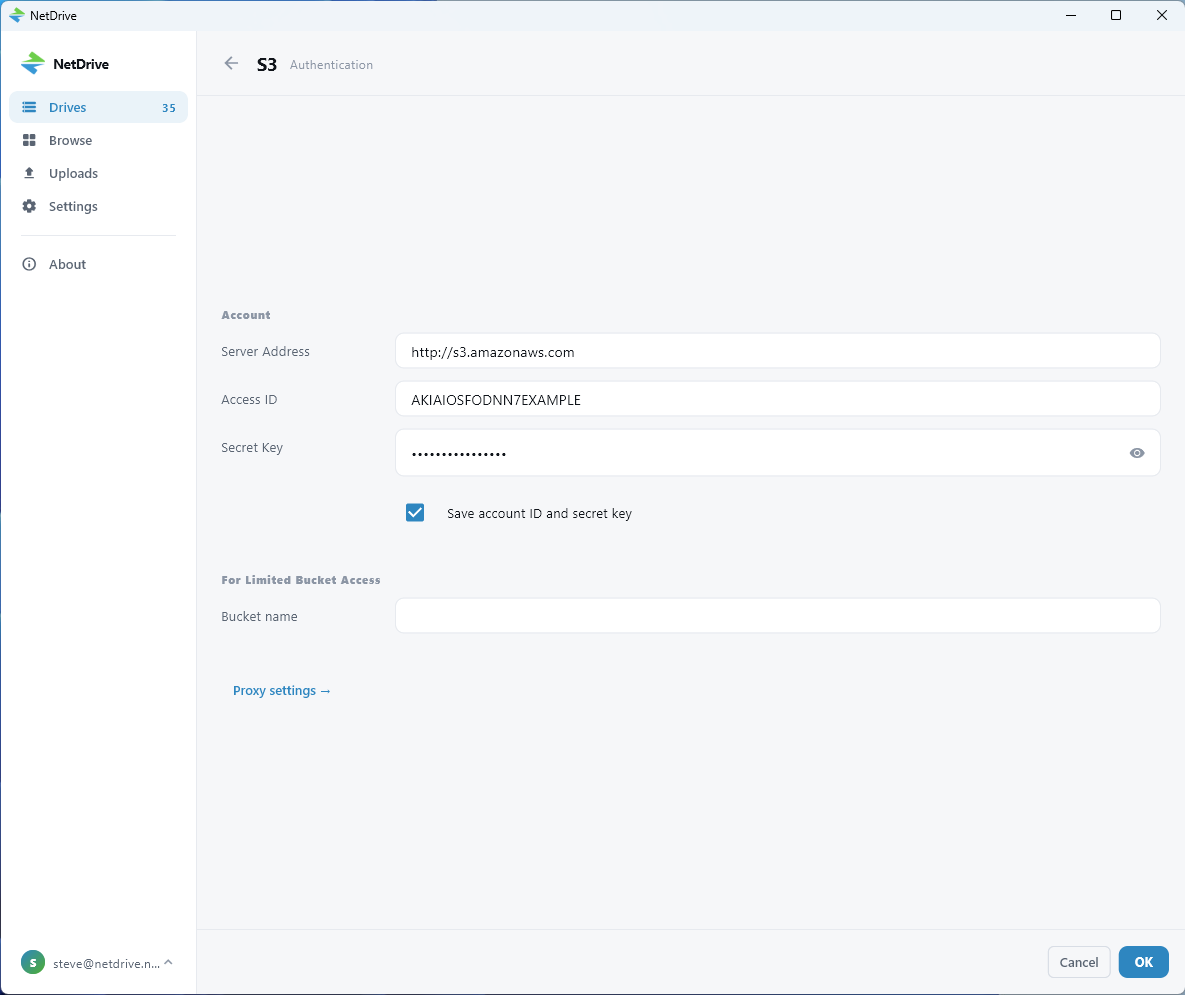
- Click Connect. The S3 form opens with Authentication next to its title.
Fill in the fields described below, and click OK.
When NetDrive connects, Connected appears under Storage type.
- If you want, click Options to change the options below, or click Browse next to Remote path to show only one bucket or folder.
- Click Add.
If the connection fails, the reason appears under Storage type. Check the fields and click Connect again. See Connect to your storage.
The S3 form
Account
- Server Address: the S3 server. It is
http://s3.amazonaws.comby default.- For Amazon S3, you can keep it. You don't need to enter a region; NetDrive finds the region of each bucket.
- For S3 compatible storage, enter the server address your provider gives you, for example
https://s3.example.com. - Start the address with
https://to connect over HTTPS. Without a scheme, NetDrive useshttp://.
- Access ID: the access key ID.
- Secret Key: the secret key of that access key.
- Save account ID and secret key (selected by default): keeps the access key with the drive. See Save authentication information.
For Limited Bucket Access
- Bucket name: leave it empty if your access key can list all your buckets. If the key is allowed to use only one bucket and cannot list buckets, enter that bucket's name here.
Folders in the drive
The top of the drive shows your buckets. Folders and files are inside the buckets.
Options
Click Options in the form. You can open it before you connect.
- Enable rename/move folder (selected by default): S3 has no real folders, so renaming or moving a folder copies every file in it and can take a long time. If you clear this option, NetDrive refuses to rename or move folders on this drive. Files can still be renamed and moved.
- Use path-style instead of virtual-hosted style: NetDrive puts the bucket name in the path of the address (
server/bucket) instead of in the host name (bucket.server). Select it if your S3 compatible storage needs path-style addresses. Buckets whose names have capital letters always use path style. - Total space: the total size, in TB, that the drive reports to your computer.
- Bandwidth: the speed limit for this drive in KB/s.
0(the default) means no limit. - Connection Timeout: how many seconds NetDrive waits when it connects to the server. The default and smallest value is
10.
Click OK to keep your changes. The drive's proxy is set with Proxy settings at the bottom of the screen; see Proxy for this drive.